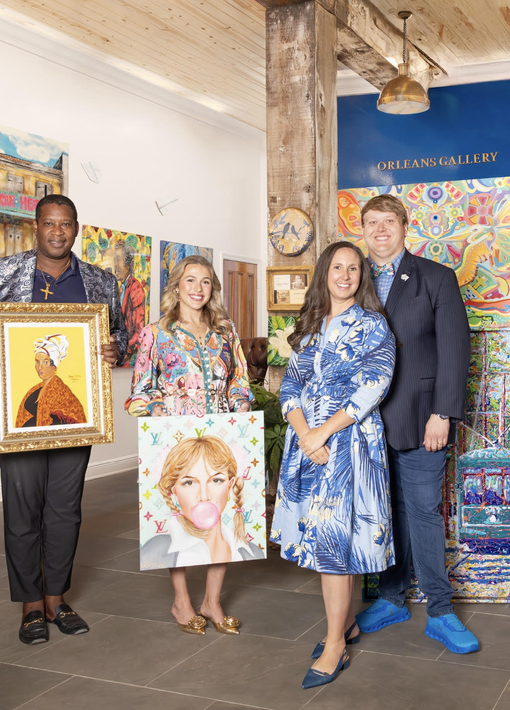
In June, Orleans Gallery presents Studies from Venice. This show features studies for artwork currently showing in the European Cultural Centre exhibition at the 2026 Venice Biennale. With pieces by nine regional artists, “Orleans Rising” begins with the inception of New Orleans, moves through Hurricane Katrina, and ends by honoring the rebirth of the city. The June show expands to include newly created work by several artists that was inspired by Venice. Featured artists include: Andrew Lamar Hopkins, Adam Trest, Joe Mustachia, Tony Bernard, Michie Cooper, Jen Morgan, Kloé Donley, Karen Ocker, and Morgan Gray.
Curated by Orleans Gallery for the Venice Biennale, this exhibition begins with New Orleans’ cultural history, moves into the inflection point of Hurricane Katrina in 2005, and ends with the rebirth and hopeful future of the city’s culture bearers. Situated 20 years after the devastation of the storm, this exhibition examines New Orleans’ sustaining of its history through art and celebration.
Andrew Lamar Hopkins’ singular view of Creole history leads the show with Venus Floating on the Mississippi River, representing the ceremonial beginnings of life in New Orleans. A Creole Apothecary, Marie Laveau, Pere Antoine, Café de Exiles, and Creole Father and Son follow, together presenting an interwoven tapestry of religion, medicine, status, and culture in 18-19th century New Orleans. Karen Ocker’s reliquaries then raise the Father of Jazz Louis Armstrong and Mother of Gospel Mahalia Jackson to sainthood.
Adam Trest’s triptych tells the story of Katrina in three parts: the storm rolling in as a band plays; the waters rising around a lone trumpet player; finally he rises above the waters, affirming that the culture of New Orleans will always transcend hardship. Alongside, a sewn piece by Michie Cooper depicts a vibrant Creole cottage marred with the Katrina Cross.
Representing the aftermath, Joe Mustachia depicts the first Second Line after the storm, a celebration backdropped by the wreckage of Katrina. Below, a flash cuts through darkness as electricity is finally returned to the city, symbolically assuring that New Orleans would see the light once again.
Looking to the future, Tony Bernard’s King George bears witness to the dawn, and his Oak represents the region’s ubiquitous, resilient flora. Michie Cooper’s free sewn cottage returns joyful color to rebuilt homes. Jen Morgan and Morgan Gray’s Mardi Gras Indians represent New Orleans' cultural legacy, continuing. Ocker and Kloé Donley imagine the city’s future musical legacy. Hopkins’ Orleans Gallery Second Line affirms the endurance of cultural institutions.
Finally, the exhibition closes with two self-portraits of Hopkins’ drag persona, Desirée, traveling from New Orleans to Venice–homages to his piece in the National Gallery of Art and to Peggy Guggenheim–depicting the cities’ shared cultural legacies.